 |
| © 2015 dbaker |
Saturday, 18 April 2015

Saturday, 14 March 2015
Dubai - a growth pole
Growth Pole? What's that?
Dubai - a growth pole
Dubai was originally a small fishing settlement. Its economy first started to grow in the 1930s with the pearl industry. Then in the late 1950s, the country began to develop its port in an attempt to become a trading hub. When oil was found in the region in the 1960s, it really kickstarted economic growth as the oil was exported, bringing in income, which could be invested in developing the area further.
The Burj el Arab
Shopping
Industry and Business
Dubai Media City
A growth pole is an area
of economic growth –
i.e. it is becoming richer. It is a place where lots of industries
and businesses choose to base themselves, often because they want to be near
other industries and businesses that are also there. Governments often try to
stimulate growth poles with low tax and other incentives.
Places on the coast have lots of advantages that make them possible growth poles. They may be ports, which attract lots of other industries, they have lots of flat land, which is good for development and they are attractive places to live, which makes it easier for industries to attract the most talented people to live there.
Places on the coast have lots of advantages that make them possible growth poles. They may be ports, which attract lots of other industries, they have lots of flat land, which is good for development and they are attractive places to live, which makes it easier for industries to attract the most talented people to live there.
Dubai - a growth pole
Dubai is an excellent example of a growth pole. It has had massive economic growth, lots of businesses and industries have set up there and the government has done lots to stimulate (encourage) this growth.
Dubai is one of the seven emirates that makes up the UAE (United Arab Emirates). The UAE is located in the Middle East.
The UAE
The Middle East
Where is Dubai?
Dubai is one of the seven emirates that makes up the UAE (United Arab Emirates). The UAE is located in the Middle East.
The UAE
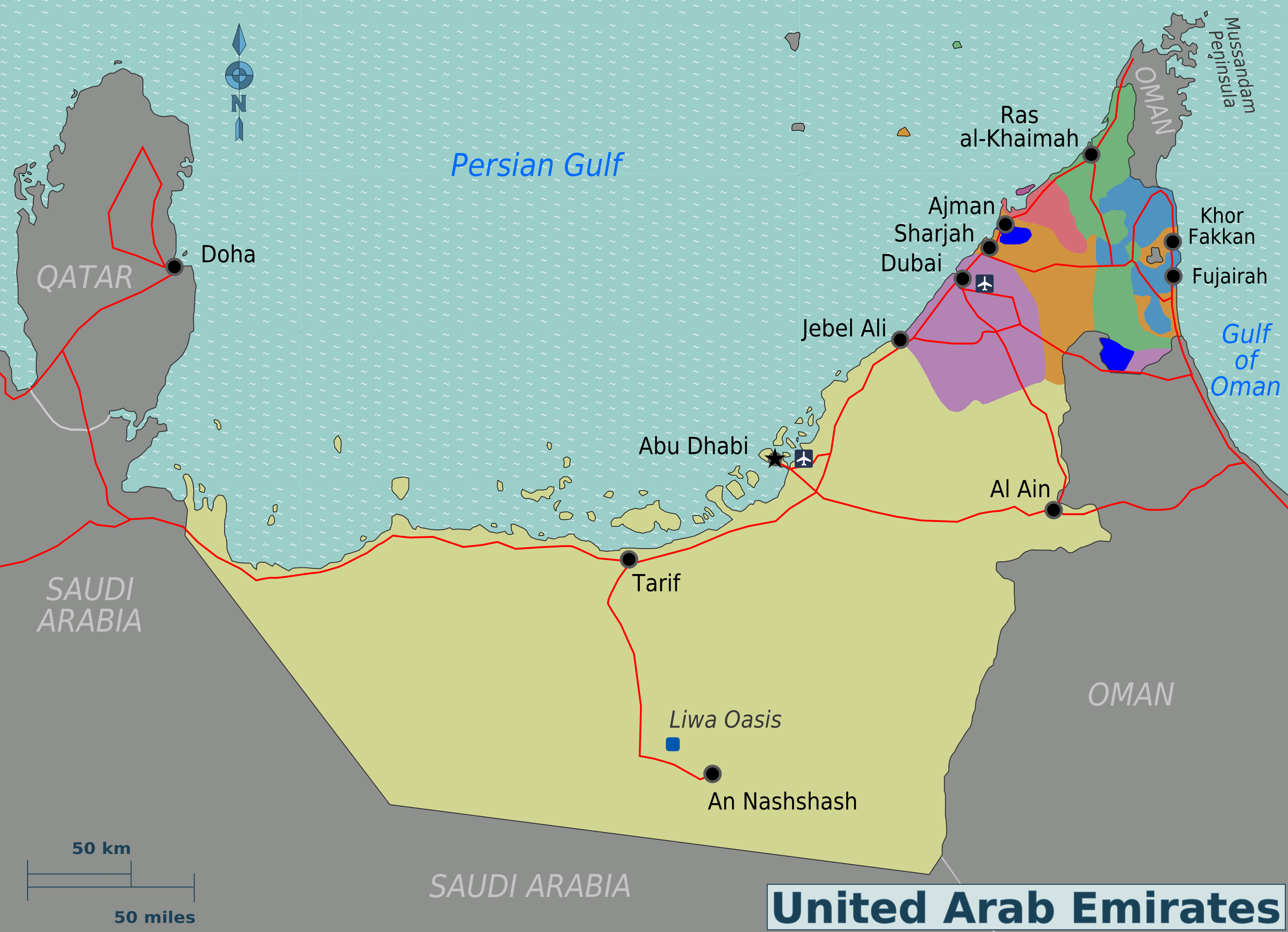 |
| Source: By Ksamahi (Own work) [CC-BY-SA-3.0 (http://creativecommons.org/licenses/by-sa/3.0)], via Wikimedia Commons |
 |
| Source: By Cacahuate, amendments by Globe-trotter and Joelf (Own work based on the blank world map) [CC-BY-SA-3.0-2.5-2.0-1.0 (http://creativecommons.org/licenses/by-sa/3.0)], via Wikimedia Commons |
Is Dubai a site of major economic growth?
Dubai was originally a small fishing settlement. Its economy first started to grow in the 1930s with the pearl industry. Then in the late 1950s, the country began to develop its port in an attempt to become a trading hub. When oil was found in the region in the 1960s, it really kickstarted economic growth as the oil was exported, bringing in income, which could be invested in developing the area further.
Dubai Creek in 1964
 |
| Source: By Noor Ali ([1]) [Public domain], via Wikimedia Commons |
By the 1980s, much of the oil was running out, so Dubai set about finding other ways to generate money. It invested in developing infrastructure, and attacting trade, tourism and industry. This move away from oil has meant that Dubai's economy has kept growing when some of the countries around it have stagnated (slowed down). Today, the UAE has become one of the most developed and wealthiest countries in the world, with a GDP pc of over $64,000.
What evidence is there that Dubai is a growth pole?
So, what has Dubai got?
Infrastructure
Tourism and Real Estate
- Port Rashid, developed as a major commercial port and now being transformed into a cruise terminal, due for completion in 2018.
- Port Jebel Ali, a massive industrial port, surrounded by a tax-free industrial zone, which attracts international businesses.
- In 1959, the then ruler of Dubai, Sheikh Rashid bin Saeed Al Maktoum, ordered the construction of Dubai International Airport, which has now become the number one airport for international travellers, with nearly 6.5 million passengers passing through it every year.
- From the 60s and 70s, Dubai's rulers invested money from in desalination plants. These remove salt from seawater so it can be used for drinking water and agriculture. It is estimated that over 98% of Dubai's water now comes from desalination.
- A transport system that has had over $20 billion dollars invested in it, as is described as 'a key driver in Dubai's Growth.'
Tourism and Real Estate
- Dubai went from having less than 50 hotels in 1985 to more than 600 in 2014.
- The '7 star' Burj el Arab, built in 1999
- Dubailand - a themepark
- The Palm Island - two man-made islands shaped like palm trees with 3,000 homes and 40 luxury hotels
- The World - 300 little islands laid out to resemble a map of the world
- The Burj Dubai - the World's tallest building
- Dubai attracted 11 million tourists in 2013.
 |
| Source: "Burj Al Arab, Dubai, by Joi Ito Dec2007" by Joi Ito |

Shopping
- Dubai is home to numerous malls, home to brands like Prada, Versace, and Dolce & Gabbana.
- The Dubai Shopping Festival, held every January and attracting 2 million visitors since 2002.
.jpg) |
Source: By Jagermesh (Own work) [CC BY-SA 3.0 (http://creativecommons.org/licenses/by-sa/3.0)], via Wikimedia Commons |
Industry and Business
- Free trade zones, like Media City and Internet City, that allow businesses to set up with little regulation or taxation.
- Internet city has attracted companies such as Hewlett Packard, Dell, IBM, and Sony.
Dubai Media City
 |
| Source: Imre Solt [GFDL (http://www.gnu.org/copyleft/fdl.html) or CC-BY-SA-3.0 (http://creativecommons.org/licenses/by-sa/3.0/)], via Wikimedia Commons |
How has the government helped Dubai grow?
As well its major investments in infrastructure, and the creation of tax and employment laws which encourage investment from abroad, the government tolerates western culture such as western dress and alcohol consumption, which attracts people from the US and Europe to live there.
Friday, 19 December 2014
Introducing Ebbsfleet Garden City
Introducing Ebbsfleet
Garden City
Help! We need more
houses!
Like many cities, the population of London is growing, with
the population predicted
to reach 9.39 million by the year 2022 and 10 millon by 2030. There are plans to improve the
transport system and many areas (such as Kidbrooke and Elephant and Castle)
have been redeveloped, but still, more houses will need to be built in order to
provide homes for everyone.
New housing developments often lead to conflict. Many people
believe that new houses should be built on brownfield land wherever possible,
but the government feels that some of London’s new housing will need to be
built on the edges of London on greenfield sites.
One of these new housing developments is Ebbsfleet Garden City,
announced by the government in
March 2014. This will be a brand new urban area in Kent, with 15, 000
homes.
What’s a Garden City?
The idea of
Garden Cities was developed in the late 19th century. It was
suggested that building self-contained settlements surrounded by greenbelts
(fields and woodland) would be better than the development of more and more
suburban sprawl.
Garden cities are meant to be sustainable; the buildings
should be good quality and there should be green space. Also, there should be
jobs and services in the garden city, and not just houses.
Why Ebbsfleet?
Ebbsfleet is near to London, where much of the demand for
new housing is. It is close to a high-speed rail line that would mean people
living in the new garden city could get to London in less than 20 minutes. It
is also close to Ebbsfleet international station, which
provides a good connection with France, which should be attractive to
businesses that want to trade with and work in mainland Europe. Also, there is
a large
disused quarry, which is ideal for redeveloping, and Paramount have plans
to build a theme park here, which would provide 27,000 jobs.

What will Ebbsfleet
Garden City be like?
Although the name suggests one big development, the truth is
that Ebbsfleet Garden City (EGC) will be built
in stages. The first part of the development is called Castle Hill, and has
only 150 homes. It is being built to feel like a ‘Kentish village’, with ‘homes
surrounding a neighbourhood garden with grassy areas for children to play, with
trees, pathways and public meeting places.’
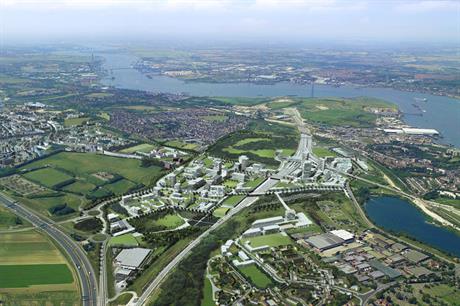 |
| Artist's impression of the Ebbsfleet development. Source: planningresource.co.uk |
What is sustainable development?
Sustainable development is defined as 'meeting the needs of the present without compromising the ability of future generations to meet their own needs', and can be imagined as a venn diagram, covering 3 main aspects; social, environmental and economic (see the image below). These are sometimes called the 'pillars' of sustainable development. Where all these pillars are being met, we get sustainability. So, for example, for the needs of people and the environment to be met, development must be bearable for both. For the needs of society to be met as well as the economy, things must be fair (equitable).
 |
| By original: Johann Dréo (talk · contribs) translation: Pro bug catcher (talk · contribs) [GFDL (http://www.gnu.org/copyleft/fdl.html), CC-BY-SA-3.0 (http://creativecommons.org/licenses/by-sa/3.0/), CC BY-SA 2.0 (http://creativecommons.org/licenses/by-sa/2.0) or CC BY-SA 2.0 fr (http://creativecommons.org/licenses/by-sa/2.0/fr/deed.en)], via Wikimedia Commons |
Sustainable developments must aim to provide residents with a good quality of life, maintain or improve the quality of the environment and ensure an economy where people have access to good jobs, earning a good wage, and where money is well invested.
Ways that this might be done include:
- Using efficient and renewable sources of energy, like solar and wind power, biofuels etc.
- Building energy efficient homes and offices, which are well insulated and well lit, to reduce energy use.
- Building homes from materials that do as little harm to the environment as possible.
- Ensuring there are green spaces that benefit wildlife and improve people's quality of life.
- Making it easy for people to walk and cycle - for example with cycle paths and pedestrian areas - this benefits the environment and helps improve quality of life.
- Developing work spaces close to home. This reduces commuting (travel to work and back) which reduces emissions from vehicles, and gives people more leisure time, as they spend less time travelling.
- Providing services such as schools, healthcare and shops that people can get to quickly and easily, ideally without driving.
- Ensuring that water is used efficiently, for example collecting rainwater and 'grey' water (water from washing up and bathing) for use in toilets/for watering the garden.
- Reducing the risk of flooding by having green areas or semi-permeable surfaces that allow water to soak way.
- Building homes that encourage people to get to know each other, creating a sense of community - homes built around communal areas can do this.
- Making sure that local people feel involved in the decisions that are made about the area, and preserving local heritage and customs.
These are not the only ways of creating sustainable developments, but they are a good start!
Will EGC be sustainable?
Developers are being encouraged to build sustainably by the government, and the developers of Castle Hill, and the other parts of EGC that are planned mention sustainability in their plans.
The Castle Hill website describes:
'...recycling where possible...whatever waste the building process creates; office buildings designed to minimise energy consumption; the recycling of water and the reduced need for cars...developing guidelines and standards for our contractors to source construction material in a sustainable manner.'
'The 150 new homes...will be three and four bedroom family homes. The development includes a range of shops, bars and restaurants and park and leisure facilities.'
The Ebbsfleet Garden City mentions:
Fasttrack buses 'to promote public transport and reduce the amount of road congestion.'
'Each area of housing will have its own primary school in a central location that is within walking distance of all houses...Easy access will be provided so that all school children can safely walk to school; parents will not need to drive their children to school.'
'...the Ebbsfleet Education Campus [with] a secondary school and a primary school, both of which will sit in extensive grounds with five football pitch sized playing fields.
The whole campus will be surrounded by trees with a neighbourhood green area on each side.'
Well, you might not know it from some of the press releases, but there is already a town in this area, called Swanscombe. Some of the people who live in Swanscombe have complained that they feel that they have not been consulted. They worry that the name 'Ebbsfleet' have be chosen to erase the historical identity of the place, and that the development will leave Swanscombe poorer, as all the focus will be on the new garden city.
The Campaign to Protect Rural England (a pressure group) argues that it would be better to build on brownfield land (derelict land that has been built on befire, often in cities), rather than develop new garden cities on the greenbelt. This is not as obvious as it might seem, as brownfield site can sometimes be more biodiverse than greenfield ones.
So, do developments like this make Ebbsfleet Garden City a sustainable development? After looking at the plans and reading what the developers and journalists and campaigners have to say, what do you think?
Thursday, 4 December 2014
Flooding Causes Case Studies
Flooding Causes Case Studies
Year 12 generated case studies of the causes of flooding in MEDCs and LEDCs. They are below. Click on them to enlarge.
 |
| Boscastle 2004 - DM and HN |
 |
| Cumbria 2009 - AM, SB and NL |
 |
| Pakistan 2010 - AS and RT |
 |
| Somerset 2014 - AI and DBo |
Sunday, 21 September 2014
Anatomy of an earthquake
In this short film, Iain Stewart covers some of the main impacts of an earthquake, including factors that can exacerbate damage and casualties. Take note of the importance of where buildings are located.
Well worth 6.45 minutes of your time!
Well worth 6.45 minutes of your time!
Tuesday, 19 August 2014
Urban Environments - Year 2 GCSE
Urban Environments - Year 2 GCSE
Year 2 GCSE students will be studying Urban Environments after the half term. AQA have this to say in their syllabus:
1. How can urban growth create challenges?
- Looking in particular at threats from pollution and the movement of traffic and people.
2. How are inequalities being reduced in urban areas in developed countries?
- Analysing socio-economic data for trends and patterns, looking at initiatives to reduce inequality and studying examples of urban regeneration.
3. What are the opportunities and challenges created by urbanisation in developing countries?
- Exploring rural-urban migration, economic development, the problems created by rapid urban growth including in squatter settlements and schemes to improve conditions in urban area in the developing world.
4. How can urban living be increasingly sustainable?
- Considering what it means to manage urban areas sustainably and investigating examples of initiatives including carbon neutral housing, greening, recycling and sustainable planning.
If you'd like to do a bit of preparatory reading:
Past papers are here - the urban section will be in the Unit 1 exams
the BBC Bitesize for Urban Environments is here
and Coolgeography also have some Urban resources here
Looking forward to seeing you all back, refreshed, and raring to go!
The world is becoming increasingly urban - it is estimated that by 2020 over 70% of the world's population will live in urban areas. In developing countries large numbers of people are moving to core urban-industrial areas in the hope of improving their quality of life. This rapid urbanisation creates challenges for urban planners in relation to housing and the supply of basic services. In developed countries, many urban areas have gone through a period of economic decline; the challenge in these areas is often about improving socio-economic conditions and addressing environmental issues.The examiners at AQA divide the urban section of the syllabus into 4 key questions:
The global future will be an increasingly urban future and this will create a need to put in place sustainable methods of managing urban living in existing areas and designing new urban centres that operate in sympathy with both people and the environment.
1. How can urban growth create challenges?
- Looking in particular at threats from pollution and the movement of traffic and people.
2. How are inequalities being reduced in urban areas in developed countries?
- Analysing socio-economic data for trends and patterns, looking at initiatives to reduce inequality and studying examples of urban regeneration.
3. What are the opportunities and challenges created by urbanisation in developing countries?
- Exploring rural-urban migration, economic development, the problems created by rapid urban growth including in squatter settlements and schemes to improve conditions in urban area in the developing world.
4. How can urban living be increasingly sustainable?
- Considering what it means to manage urban areas sustainably and investigating examples of initiatives including carbon neutral housing, greening, recycling and sustainable planning.
If you'd like to do a bit of preparatory reading:
Past papers are here - the urban section will be in the Unit 1 exams
the BBC Bitesize for Urban Environments is here
and Coolgeography also have some Urban resources here
Looking forward to seeing you all back, refreshed, and raring to go!
Tuesday, 15 July 2014
Yellowstone Supervolcano
Yellowstone is in the news again (see here) after a thermal hotspot melted asphalt on one of the roads in the park. Yellowstone is a 'supervolcano' - a volcano capable of producing eruptions that measure VEI8 on the volcanic explosivity index - 1000 times larger than standard volcanic events.
In 2006, the BBC and Discovery channel produced a drama called 'Supervolcano'. This looked at the possible impact of a massive eruption at Yellowstone. The US Geological Survey described the film as an 'acceptable' attempt to show what might happen in the event of such an eruption.
Geologists say the the current hotspot activity is not an indication of a likely eruption, with Dan Hottle, the park spokesman saying, 'the supervolcano is not going to blow.'
In 2006, the BBC and Discovery channel produced a drama called 'Supervolcano'. This looked at the possible impact of a massive eruption at Yellowstone. The US Geological Survey described the film as an 'acceptable' attempt to show what might happen in the event of such an eruption.
Geologists say the the current hotspot activity is not an indication of a likely eruption, with Dan Hottle, the park spokesman saying, 'the supervolcano is not going to blow.'
 |
| Source: Thomas Moran [Public domain], via Wikimedia Commons |
Subscribe to:
Posts (Atom)